Buyers no longer trust brands on first contact. They check proof first.
Before someone enquires, books a call, visits a store or buys online, they look for reputation signals that tell them whether a business is credible, active and safe to choose. These signals include recent reviews, website quality, Google presence, proof of results, response speed, real human visibility and consistency across search, social media and AI-driven discovery.
Strong reputation signals reduce doubt. They make buyers feel more confident, lift enquiries, improve conversion rates and make every marketing channel work harder.
What are reputation signals?
Reputation signals are visible proof points that buyers use to judge whether a business is credible, active, experienced and safe to buy from.
They are the trust markers people check before making a decision. Some are obvious, such as Google reviews, testimonials and case studies. Others are more subtle, such as how fast a website loads, whether the business responds to reviews, how clear the offer is, and whether the brand looks consistent across Google, social media, ads, search results and AI summaries.
A strong reputation is not built from one signal. It is built when several trust signals tell the same story: this business is real, reliable and capable of delivering what it promises.
Why reputation signals matter more in 2026
Buying behaviour has changed. Customers now do more research before they speak to a business, and many already have a strong opinion before they submit an enquiry.
In B2B, Gartner’s 2026 sales research found that 67% of B2B buyers prefer a rep-free buying experience. That means many decision-makers want to research, compare and validate options before speaking to a salesperson.
For local and consumer-facing businesses, online reviews remain one of the strongest trust signals. BrightLocal’s 2026 Local Consumer Review Survey confirms that consumers continue to use reviews to assess businesses before taking action. Buyers are not only checking star ratings. They are also looking at review recency, review detail, business responses, photos, videos and whether the review profile feels real.
This matters because reputation now sits between visibility and conversion.
A business can rank well, run strong ads and produce good content, but if the proof does not match the promise, buyers hesitate. The brands winning today are not always the loudest. They are the easiest to trust.
8 Reputation signals that influence buyers before they contact you
1. Recent, detailed Google reviews
Recent, detailed Google reviews show that real customers are still choosing the business and having positive experiences.
A high star rating helps, but buyers increasingly look beyond the number. They want to see what people actually say, how recent the feedback is, whether reviews mention specific services, and whether there are photos, videos or detailed examples.
Why it moves buying decisions:
Fresh reviews reduce uncertainty. They show that the business is active, trusted and still delivering. Old reviews may still help, but they do not carry the same confidence as recent feedback from customers who bought, booked or enquired within the last few weeks or months.
Example:
A local service business with 150 reviews, a 4.8-star rating and several recent reviews mentioning punctuality, quality and communication will usually feel safer than a competitor with a similar rating but no reviews from the last year.
What good looks like:
- Reviews collected consistently, not only in short bursts
- Specific comments about the product, service or result
- A mix of short and detailed reviews
- Business replies that sound human and professional
- Photos or videos where relevant
- No suspicious pattern of generic, over-polished reviews
2. Google Business Profile strength

A strong Google Business Profile helps buyers quickly confirm that a business is legitimate, active and relevant to their needs.
For local businesses, the Google Business Profile is often the first reputation checkpoint. Buyers use it to check reviews, photos, opening hours, location, services, contact details and recent activity. Google also says that more reviews and positive ratings can help local ranking, which makes reputation important for both visibility and trust.
Why it moves buying decisions:
A complete and active profile makes the business feel easier to verify. A weak or outdated profile creates friction, especially when buyers are comparing several options in search or Google Maps.
Example:
A restaurant with recent photos, current opening hours, clear menu information and active review responses feels safer than one with missing details and unanswered complaints.
What good looks like:
- Correct name, address, phone number and website
- Accurate opening hours
- Clear service or product categories
- Recent photos
- Regular review responses
- Service descriptions that match the website
- No conflicting information across directories
3. Website quality and conversion experience
.webp)
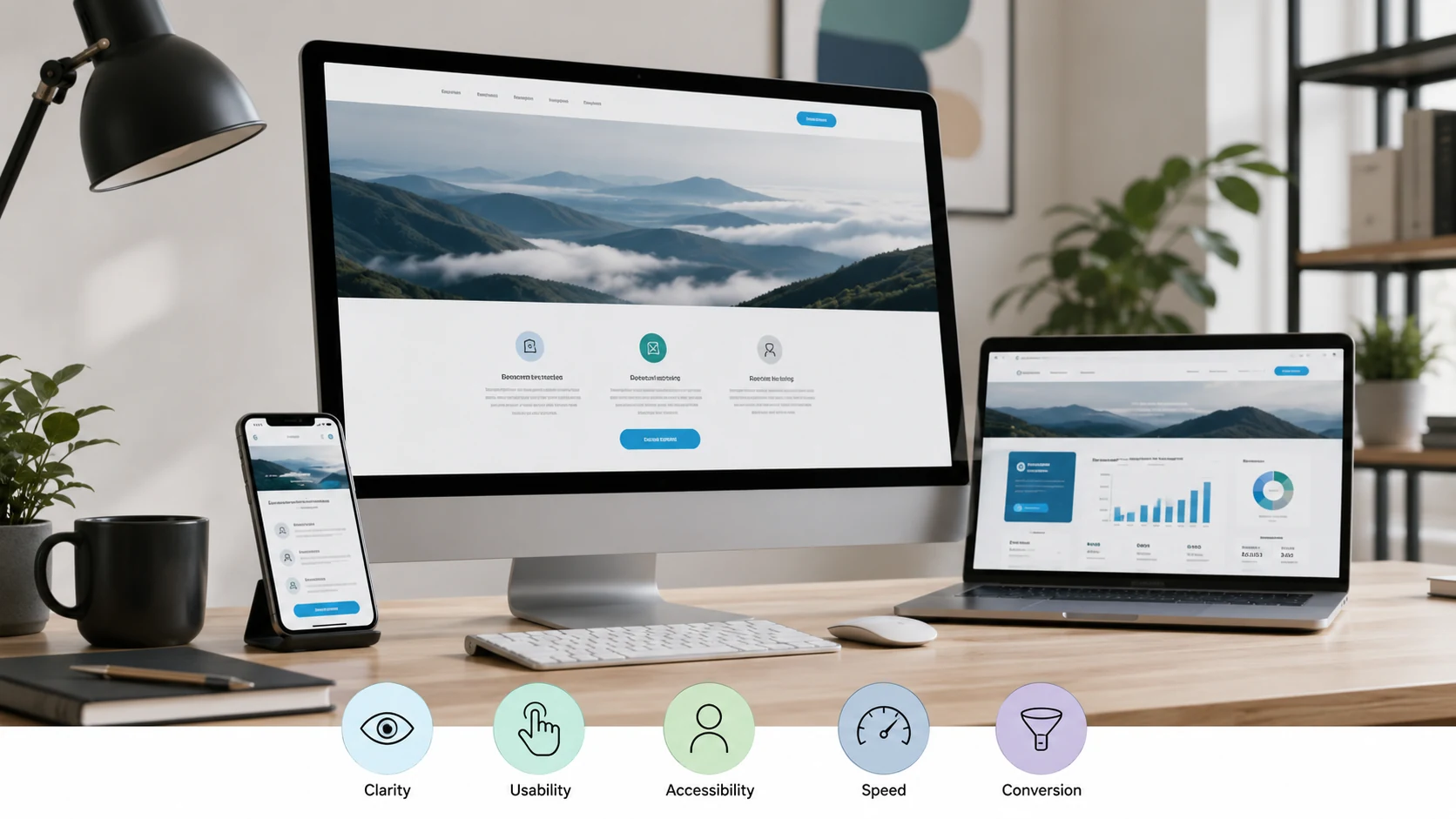
Your website is one of the strongest reputation signals because it shows buyers how seriously your business presents itself.
A weak website can damage trust before the sales conversation begins. Slow pages, outdated design, unclear messaging, broken forms, poor mobile experience or vague service pages can make buyers question whether the business is professional enough to choose.
This is why website quality is not just a design issue. It is a conversion issue.
Why it moves buying decisions:
Buyers use the website to validate the business. If the site looks current, loads quickly, explains the offer clearly and makes the next step easy, the buyer feels more confident taking action.
Example:
A construction company with clear service pages, project photos, enquiry options, testimonials and location relevance will usually convert better than a competitor with a thin homepage and no visible proof of work.
What good looks like:
- Clear value proposition above the fold
- Fast loading on desktop and mobile
- Simple navigation
- Strong service pages
- Real photos where possible
- Visible trust signals
- Clear calls to action
- Easy enquiry, booking or checkout process
4. Proof of results

Proof of results shows buyers that a business can deliver, not just claim expertise.
Case studies, project examples, before-and-after comparisons, performance summaries and client outcomes are stronger than generic statements such as “we are the best” or “we deliver quality results.” Buyers want evidence.
For service businesses, proof of results is often the difference between interest and enquiry.
Why it moves buying decisions:
Buyers reduce risk by checking whether the business has solved similar problems before. The more specific the proof, the easier it is for them to believe the brand can help them too.
Example:
A digital growth agency saying “we improve conversion rates” is less convincing than showing a project where the website, content, advertising and tracking improvements helped a client generate more enquiries or sales.
What good looks like:
- Real client or project names where possible
- Clear problem, action and outcome structure
- Measurable results where available
- Screenshots, visuals or examples
- Honest context around what was done
- No invented or exaggerated figures
5. Visible human proof
Visible human proof shows that there are real people behind the brand.
Buyers trust businesses more easily when they can see who is involved, who leads the company, who delivers the service, and who has already trusted the brand. This can include founder content, team photos, client testimonials, behind-the-scenes posts, interviews, project walkthroughs and named client references.
Anonymous brands have to work harder to earn trust.
Why it moves buying decisions:
Human visibility reduces doubt. It makes the business feel more accountable, approachable and real.
Example:
A consulting firm with visible founders, real team bios, client interviews and thought leadership content will usually feel more credible than a faceless site with generic stock imagery.
What good looks like:
- Real founder or team presence
- Clear roles and expertise
- Named testimonials where possible
- Real project examples
- Behind-the-scenes content
- Human responses on social media and reviews
6. Clear offer and transparent information
A clear offer helps buyers understand what the business does, who it helps and what to do next.
If people cannot understand your offer within seconds, they are more likely to leave, compare or delay the decision. Confusion weakens trust. Clarity builds it.
Transparent information does not mean every business needs to show fixed prices. It means the buyer should understand the service, process, outcome, next step and whether the business is relevant to them.
Why it moves buying decisions:
Buyers want to avoid wasting time. Clear information helps them qualify themselves before enquiring, which usually leads to better-fit leads and stronger conversion.
Example:
A premium service provider may not list exact pricing, but it can explain the type of clients it works with, the consultation process, what is included and how to get started.
What good looks like:
- Clear headline and offer
- Simple explanation of services
- Defined audience or use case
- Process overview
- Relevant FAQs
- Clear CTA
- No vague claims without context
7. Response speed and active communication
Fast, helpful communication is a reputation signal because it shows buyers that the business is active and attentive.
This matters most when the buyer is comparing several providers. If one business responds quickly and clearly while another takes days, the faster business often wins the trust advantage before price is even discussed.
Response speed also applies beyond email and phone. It includes replying to reviews, answering social messages, handling comments, following up on forms and making the buyer feel guided after they take action.
Why it moves buying decisions:
People associate slow responses with poor service. Fast responses make the business feel organised, available and easier to work with.
Example:
A buyer requesting quotes from three service providers may choose the one that responds first with clear next steps, even if it is not the cheapest.
What good looks like:
- Fast reply to enquiries
- Clear next steps after form submission
- Review responses that feel professional
- Social messages handled consistently
- No abandoned comment sections
- No outdated automated replies
8. Cross-channel and AI visibility

Cross-channel visibility means your website, Google profile, social media, ads, third-party listings, reviews and AI search presence all reinforce the same message.
This matters more as buyers use more sources to validate decisions. A buyer may find a business through Google, check reviews, scan the website, look at Instagram, compare competitors, ask an AI tool for options, then return to the site before enquiring.
If each channel tells a different story, trust weakens. If every channel supports the same positioning, trust compounds.
Why it moves buying decisions:
Consistency makes a brand easier to understand and easier to believe. It also helps AI systems and search engines connect the business with the right topics, services, locations and proof points.
Example:
A growth agency that talks about conversion-focused websites, SEO/GEO, content, advertising, data and AI across its website, case studies and service pages creates a clearer trust footprint than an agency with disconnected messaging across each channel.
What good looks like:
- Consistent business name, offer and positioning
- Aligned website, social and Google messaging
- Clear service pages
- Structured content that answers buyer questions
- Case studies linked to services
- Reviews and testimonials that support the same claims
- Content designed for both search engines and AI summaries
Reputation signals buyers ignore or distrust
Not every signal builds trust. Some signals look impressive at first glance but create doubt when buyers look closer.
Modern buyers are more sceptical. They have seen too many exaggerated claims, fake reviews, generic testimonials and over-designed websites that fail to prove anything meaningful. The wrong signals can make a brand feel less trustworthy, not more.
Here are reputation signals buyers often ignore or distrust:
Generic five-star testimonials with no detail
A testimonial that says “Great service” may help slightly, but it does not answer the buyer’s real question: why should I trust this business? Strong testimonials mention the problem, experience, result or reason the customer would recommend the brand.
Stock images posing as real work
Stock imagery can support design, but it should not replace real proof. When a business uses generic photos to represent services, projects or people, buyers may question what is actually real.
Inflated claims with no proof
Claims such as “number one,” “best in the industry” or “guaranteed results” need evidence. Without proof, they sound like marketing noise.
Inactive social profiles
A business with abandoned social media pages can look inactive, even if it is still operating. This is especially risky when the last post is months or years old.
Stale case studies with no current relevance
A case study from several years ago may still be useful, but buyers want to know whether the business is still active and capable today. Current work, updated results and fresh examples matter.
Awards or badges with no context
Awards can help, but only when buyers understand what they mean. A badge with no explanation, source or relevance rarely moves a decision on its own.
Review profiles that look fake or over-polished
Buyers can often sense when reviews feel unnatural. A review profile with repeated phrasing, no detail or sudden bursts of similar reviews can create suspicion.
Reputation signals by business type
Different buyers look for different proof. The right reputation signals depend on the business model, price point and decision risk.
The key is to match the proof to the decision.
A restaurant needs strong reviews, photos and map visibility. An ecommerce brand needs product reviews, delivery confidence and social proof. A B2B agency needs case studies, process clarity, strong positioning and evidence of expertise.
How reputation signals work together
Reputation signals rarely work alone. Buyers build trust by connecting several proof points across the journey.
A buyer may first notice a brand through search, an ad, a social post or an AI-generated answer. From there, they might check reviews, visit the website, compare competitors, scan case studies, look at social media and then decide whether to enquire.
Each step either strengthens or weakens trust.
For example, strong Google reviews may create interest, but a slow or confusing website can stop the buyer from taking action. A premium website may create confidence, but a weak review profile can raise doubt. A strong case study may support expertise, but inconsistent messaging across social media and ads can make the brand harder to understand.
The strongest brands make every touchpoint support the same decision.
They do not rely on one review, one homepage or one ad. They build a trust system where every visible signal makes the buyer feel more confident.
How to audit your reputation signals
A reputation audit helps you see your brand the way a buyer sees it. The goal is not just to find gaps. It is to identify the trust signals that may be helping or hurting conversion.
Use this checklist:
- Check your Google reviews from the last 90 days
Are customers still leaving fresh reviews? Do they mention specific services, products or experiences? - Compare your star rating against direct competitors
Are you above, equal to or below the businesses buyers are likely comparing you with? - Review your homepage trust signals
Does the first screen clearly explain who you help, what you do and why buyers should trust you? - Check whether your case studies show measurable outcomes
Do they include real problems, actions and results, or do they read like generic project summaries? - Assess your social media consistency
Do your profiles look active, relevant and aligned with your current offer? - Search your brand name
What appears on Google? Are the results positive, accurate and consistent? - Test whether your offer is clear within five seconds
Ask someone unfamiliar with your business to open your website and explain what you do. - Review whether your photos, testimonials and claims feel real
Remove or improve anything that feels vague, outdated, exaggerated or disconnected from actual buyer proof.
A strong reputation audit should leave you with clear actions, such as collecting more recent reviews, improving service pages, updating case studies, strengthening social proof, clarifying messaging or fixing inconsistencies across search and social channels.
How Hackd Growth builds reputation that converts
Reputation is not built from one channel. It is built through the full digital system buyers use to judge your brand.
Hackd Growth helps ambitious brands strengthen that system across strategy, website experience, branding, SEO/GEO, content, social media, advertising, analytics and AI-driven growth. The goal is not to make a business look trustworthy on the surface. The goal is to make trust easy to verify at every step of the buyer journey.
That can include:
- Brand identity and positioning: creating a sharper market position, stronger messaging and a more consistent brand system.
- Website experience: building conversion-focused pages that explain the offer clearly and guide buyers towards action.
- SEO and GEO: structuring content so search engines and AI-driven platforms can understand, surface and summarise the brand accurately.
- Content creation: producing service pages, blogs, case studies, social content and campaign messaging that answer buyer questions.
- Social proof and case studies: turning real projects, client outcomes and testimonials into trust-building assets.
- Advertising and funnels: connecting paid traffic to landing pages and offers that feel credible and conversion-ready.
- Analytics and optimisation: tracking what buyers do, where they drop off and which reputation signals help move them forward.
For brands that want to grow, reputation should not be treated as a passive outcome. It should be engineered into the website, content, search presence, creative, ads and customer journey.
If buyers are already checking proof before they contact you, your digital presence should make the decision easier.
Final thoughts
The strongest reputation signals in 2026 are the ones buyers can verify quickly. Recent reviews, strong Google presence, a clear website, real proof of results, human visibility, transparent offers, fast communication and consistent cross-channel visibility all reduce doubt.
Trust is no longer built after the first conversation. It is built before the buyer ever contacts you.
The brands that win are the ones that make trust easy to see, easy to check and easy to believe.
FAQ
1. What are reputation signals in marketing?
Reputation signals are visible proof points that help buyers decide whether a business is credible, active and safe to choose. They include reviews, testimonials, case studies, website quality, Google Business Profile strength, social proof, response speed, brand consistency and clear information about the offer.
2. Do Google reviews affect buying decisions?
Yes. Google reviews affect buying decisions because they help buyers judge trust, quality, reliability and recency. A strong review profile can make a business feel safer to contact, especially when reviews are detailed, recent and supported by professional business responses.
3. What reputation signals matter most for local businesses?
For local businesses, the most important reputation signals are recent Google reviews, a complete Google Business Profile, accurate contact details, service-area relevance, real photos, fast response times and visible proof of previous work. Buyers often compare these signals directly in Google Search and Maps.
4. What makes a business look trustworthy online?
A business looks trustworthy online when its website is clear, its reviews are recent, its offer is easy to understand, its contact details are accurate, its social media feels active and its claims are supported by real proof. Trust increases when every channel tells a consistent story.
5. How do reputation signals affect conversion rates?
Reputation signals affect conversion rates by reducing buyer hesitation. When people see strong reviews, clear messaging, case studies, active communication and proof of results, they feel more confident taking action. Weak or missing signals can cause buyers to delay, compare or leave.
6. How often should a business collect new reviews?
A business should collect new reviews consistently, not only during campaigns or after a problem. For many local and service businesses, aiming for a steady flow of recent reviews each month is better than collecting many reviews at once and then going quiet.
7. Are testimonials or case studies better for B2B trust?
Case studies are usually stronger for B2B trust because they show context, problem-solving and outcomes. Testimonials still matter, but they are more persuasive when paired with specific project details, measurable results or named client proof. The strongest B2B reputation strategy uses both.
8. How can a business improve reputation signals quickly?
A business can improve reputation signals quickly by updating its Google Business Profile, requesting recent customer reviews, improving homepage clarity, adding real testimonials, publishing current case studies, fixing outdated social profiles and making enquiry steps easier. The fastest gains usually come from removing trust gaps buyers already notice.


.png)

.jpg)