If your business is not growing despite consistent marketing, increasing your activity or budget is rarely the first solution. The problem is usually a leak between attracting attention, converting demand, closing sales and retaining profitable customers.
Your campaigns may be generating the wrong traffic. Your website may be losing qualified prospects. Your tracking may be reporting misleading results. Your sales process may be slow, or your customer acquisition costs may be consuming the value marketing creates.
When marketing is running but growth has stalled, diagnose the complete path from audience to revenue. Find where qualified prospects disappear, where costs become unsustainable or where customers fail to return before spending more on promotion.
The Seven-Stage Marketing-to-Growth Diagnostic
Start Here: Which Growth Problem Do You Have?

Before changing campaigns, determine which of these three situations best describes your business.
This distinction matters because the same marketing action will not fix every problem.
Increasing advertising may help a business that has a proven offer, strong conversion rate and room to serve more customers. It can make the situation worse when the website is underperforming, leads are unsuitable or the business loses money on each new customer.
Why More Marketing Rarely Fixes Stalled Growth
Marketing activity and business growth are not the same thing.
A company can publish content, run paid campaigns, grow website traffic and increase social engagement without creating sustainable revenue. These activities only contribute to growth when they move the right audience through a working commercial system.
More marketing usually fails to solve stalled growth for three reasons:
The underlying leak remains: More visitors enter the same weak landing page, form or sales process.
The wrong metric is being optimised: The campaign generates clicks, impressions or cheap leads rather than profitable customers.
The business scales inefficiency: Higher spending increases acquisition costs, service pressure or losses instead of improving profit.
The purpose of the diagnostic is not to identify whether marketing exists. It is to determine whether every stage between marketing and revenue is doing its job.
1. Is Your Offer and Message Attracting the Right Attention?
Marketing cannot create consistent growth when the audience does not understand the offer, see its relevance or believe it is worth acting on.
A weak message often produces one of two outcomes. People ignore the campaign completely, or they click with the wrong expectations and leave after reaching the website.
Symptoms to look for
- Low advertisement click-through rates
- High landing-page exits
- Enquiries asking what the business actually provides
- Prospects focusing only on price
- Different campaigns producing the same weak response
- High engagement with content but little commercial action
Check these metrics
- Click-through rate by advertisement and message
- Landing-page engagement
- Conversion rate by campaign
- Search terms or audience segments producing enquiries
- Enquiry quality by offer
- Revenue generated by each proposition
Do not judge the message from clicks alone. A broad promise may attract attention while generating unsuitable prospects.
The advertisement, landing page and sales conversation should communicate the same offer. When the advertisement promises an affordable, immediate solution but the landing page presents a premium, consultative service, the customer journey breaks before the sale begins.
What to fix
- State the problem being solved in clear language.
- Explain who the offer is intended for.
- Make the commercial value specific.
- Match the landing-page message to the campaign.
- Test different propositions, not only cosmetic creative changes.
- Remove vague claims that could apply to any competitor.
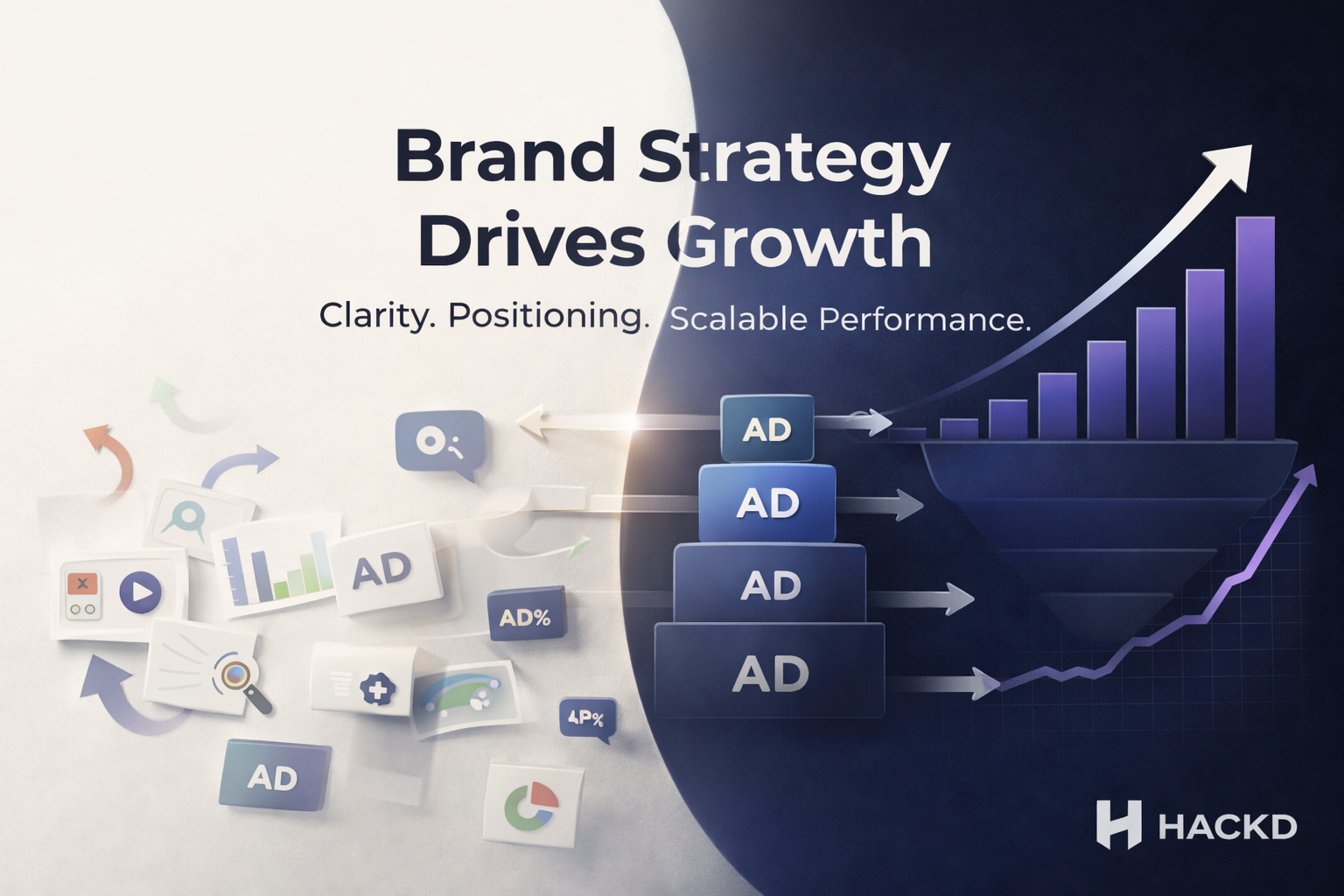
This remains an execution diagnosis. When the business cannot define its target market, competitive position or long-term direction, the underlying issue may sit among its broader growth strategy mistakes, rather than within campaign execution.
2. Are You Attracting Qualified Traffic?
More website traffic is not automatically better marketing. Growth depends on attracting people who have the right problem, location, budget, timing and level of intent.
A campaign can appear healthy because it generates affordable clicks while sending people who are unlikely to buy.
Symptoms to look for
- Traffic increases without a matching increase in enquiries
- Leads come from locations the business cannot serve
- Search campaigns trigger for irrelevant terms
- Social campaigns attract engagement but little buying intent
- Prospects cannot afford the offer
- Website visitors consume information without entering commercial pages
Check these metrics
- Conversion rate by channel
- Qualified lead rate by campaign
- Revenue by traffic source
- Search-term relevance
- Geographic performance
- New customer acquisition cost by channel
- Engagement with high-intent pages
Review the sources that produce customers, not merely sessions. Two channels can generate the same number of leads while producing very different revenue and profit.
Google Ads recommends using conversion values to measure the business impact of actions rather than treating every conversion as equally valuable. Values can help distinguish campaigns that generate higher-value outcomes from those that simply produce more recorded actions.
What to fix
- Exclude irrelevant locations, search terms and audiences.
- Separate awareness campaigns from lead-generation campaigns.
- Tighten the relationship between audience intent and offer.
- Compare lead quality across channels.
- Assign values to commercially different conversions.
- Move budget towards sources producing qualified customers.
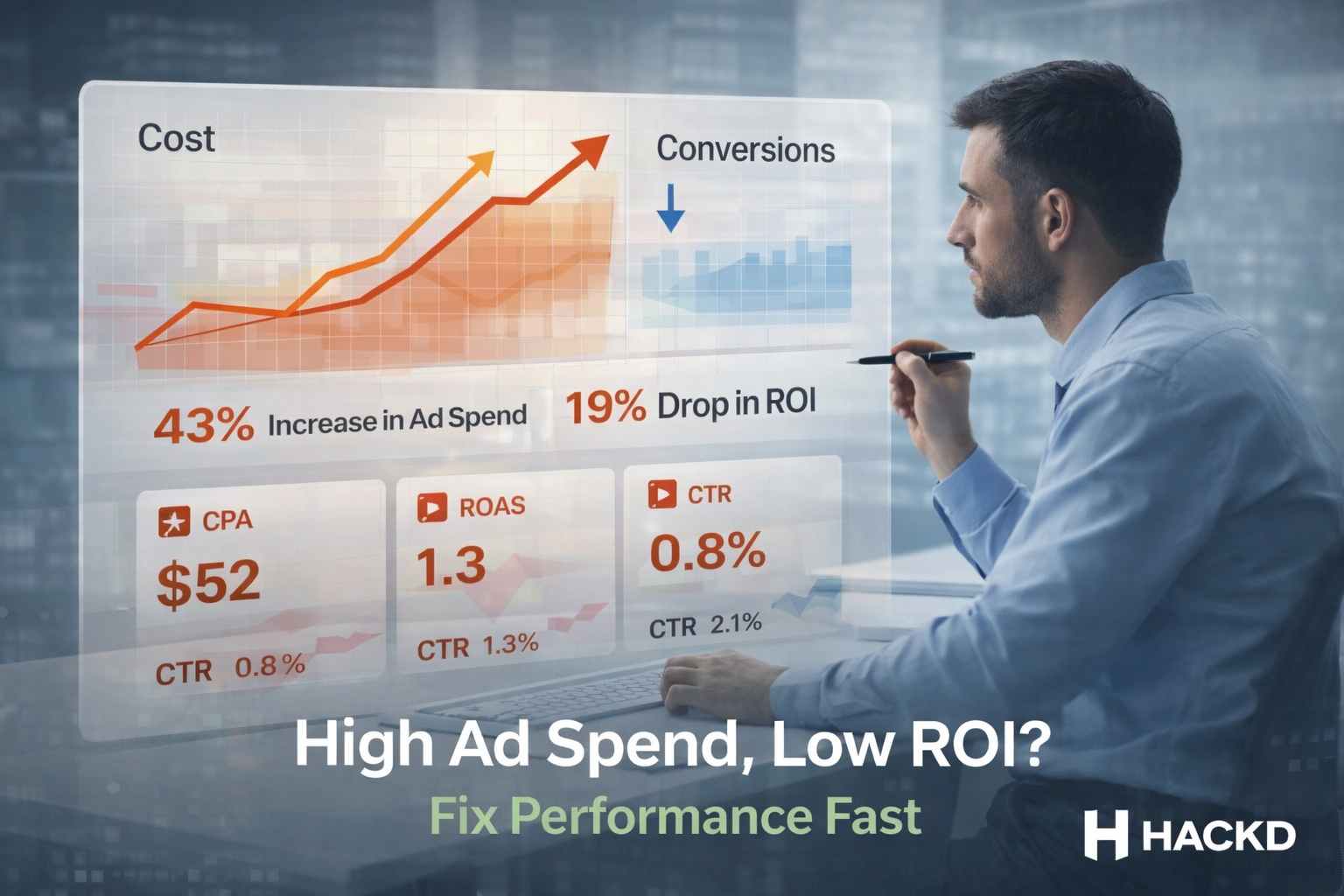
A paid campaign that brings plenty of traffic but little commercial value may need the deeper diagnosis covered in why high ad spend produces low ROI.
3. Is Your Website Turning Interest Into Action?

Marketing creates the opportunity. The website must convert that opportunity into an enquiry, booking, purchase or other meaningful next step.
A strong campaign cannot compensate indefinitely for a confusing landing page, weak mobile experience or complicated form.
Symptoms to look for
- Advertisement engagement is healthy but conversion is low
- Visitors begin forms without completing them
- Mobile users convert far less often than desktop users
- Key information is difficult to find
- The primary call to action is unclear
- Pages load slowly or shift while visitors interact
- The landing page does not answer common objections
Check these metrics
- Landing-page conversion rate
- Form starts against completed submissions
- Conversion rate by device
- Call-to-action clicks
- Error rate by form field
- Page load and interaction performance
- Exit rate from high-intent pages
A conversion problem is not solved by changing button colours at random. Begin with the user’s decision process.
The page should establish what is being offered, who it is for, what makes it credible and what the visitor should do next. Pricing, delivery, timing, proof and risk should be addressed near the point where they affect the decision.
What to fix
- Match the landing page to the advertisement.
- Place the main offer and action near the top.
- Reduce unnecessary form fields.
- Improve mobile readability and controls.
- Add relevant proof near the decision point.
- Explain the next step after submission.
- Remove competing calls to action.
- Improve load speed and visual stability.
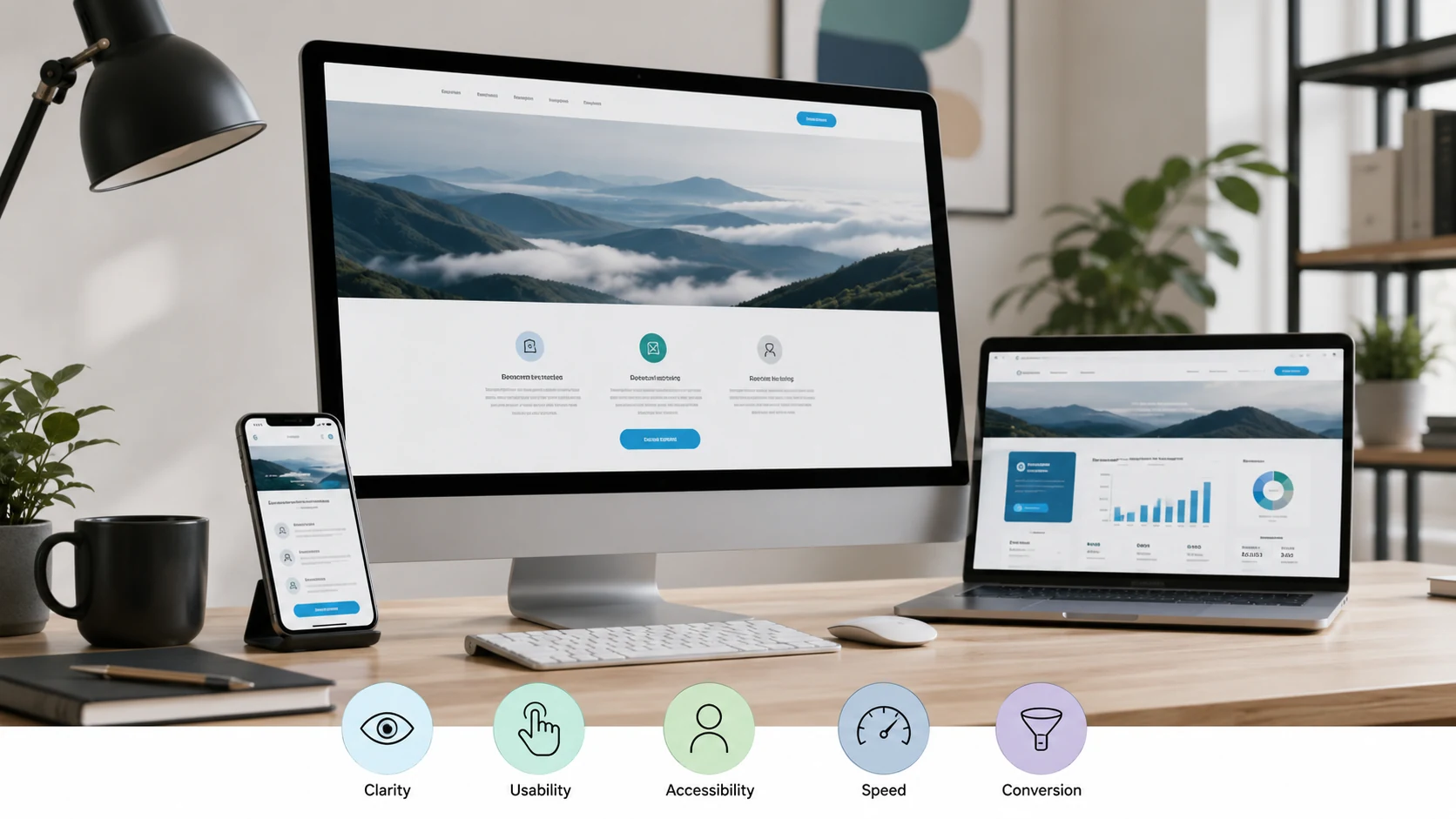
Hackd Growth’s conversion-focused web and app development connects site architecture, usability, performance and analytics so the experience after the click supports the campaign rather than weakening it.
4. Can You Trust Your Marketing Data?

A business cannot diagnose growth accurately when its measurement system is incomplete or inconsistent.
Marketing may appear to be failing because calls, offline sales or repeat purchases are not recorded. It may also appear successful because duplicate conversions, low-value actions or platform attribution inflate the reported outcome.
Common tracking problems
- Forms are not recorded consistently
- Calls are not attributed to their source
- The same purchase fires more than once
- Newsletter sign-ups are counted as sales leads
- Platform results do not match actual revenue
- CRM outcomes are disconnected from campaign data
- Test submissions remain in reports
- Revenue values are missing or incorrect
- Attribution settings differ across platforms
Google Ads conversion tracking is designed to connect advertisement interactions with valuable actions such as purchases, calls and leads. The business must still define which actions matter and configure them correctly.
Attribution also affects how credit is distributed across the customer journey. A prospect may encounter several campaigns before converting, which means last-click reporting can tell a different story from a model that considers multiple interactions.
Check these areas
- Are all important actions tracked?
- Do recorded sales match accounting or ecommerce records?
- Are duplicate events present?
- Are calls and offline outcomes included?
- Can marketing leads be followed through to revenue?
- Are primary and secondary conversions separated?
- Is the attribution model understood?
- Are conversion values based on real commercial value?
What to fix
- Audit tracking across the website and advertising platforms.
- Reconcile platform results with actual business records.
- Connect qualified and closed leads back to their source.
- Remove duplicate and low-value conversion actions.
- assign realistic values to different outcomes.
- Document attribution settings and reporting definitions.
Reliable tracking and funnel analysis helps teams identify where people drop out, where reporting becomes distorted and which marketing decisions are supported by evidence.
5. Are Your Leads Commercially Valuable?
A growing lead count can hide a declining business result.
Marketing platforms optimise towards the actions they are given. When every form submission is treated as equally valuable, campaigns may learn to find people who complete forms easily rather than people who become profitable customers.
Symptoms to look for
- Cost per lead falls while revenue remains flat
- Sales teams reject many enquiries
- Leads request services the business does not offer
- Prospects lack the required budget
- Enquiries come from outside the service area
- Contact details are inaccurate
- Leads cannot be reached
- Conversion volume rises without an increase in closed sales
Check these metrics
- Marketing-qualified lead rate
- Sales-qualified lead rate
- Lead-to-sale conversion rate
- Revenue per lead
- Profit per acquired customer
- Disqualification reasons
- Refund or cancellation rate by source
A low cost per lead is not automatically efficient. A $20 lead that never becomes a customer costs more than a $100 lead that repeatedly produces profitable revenue.
What to fix
- Send qualification outcomes back to the marketing team.
- Adjust forms to collect essential commercial information.
- Refine targeting around high-value customer characteristics.
- Separate high-intent enquiries from low-commitment actions.
- Optimise towards qualified or closed outcomes where possible.
- Review the expectations created by advertisements.
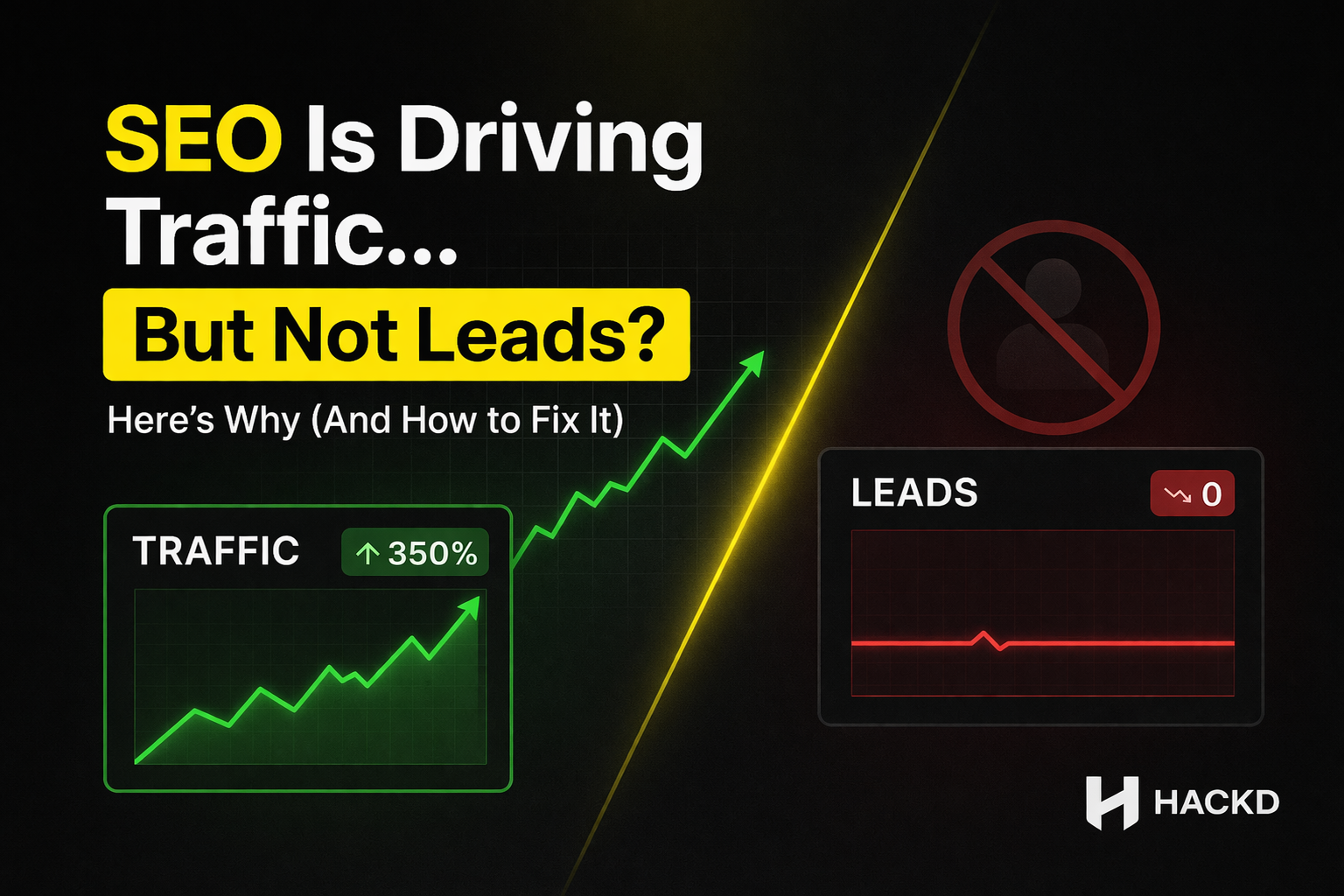
When organic visibility is growing but enquiries remain weak, the problem may require a more focused review of why SEO traffic is not generating leads.
6. Is the Drop-Off Happening After the Lead?

Marketing may be generating suitable opportunities while the sales and service process prevents them from becoming revenue.
This stage is frequently overlooked because campaign reporting often stops at the form submission.
Symptoms to look for
- Leads wait hours or days for a response
- Follow-up is inconsistent
- Sales teams cannot see the lead source or context
- Quotes are sent without further contact
- Enquiries are not prioritised by intent
- Customers purchase once but do not return
- Marketing and sales report different results
Harvard Business Review has documented how poorly many businesses handle online enquiries and highlights the commercial importance of responding promptly.
Speed is not the only issue. The first response must also help the prospect progress. An immediate automated acknowledgement is useful, but it does not replace a relevant human response when the decision requires discussion.
Check these metrics
- Time to first meaningful response
- Contact rate
- Appointment or quote rate
- Lead-to-sale conversion rate
- Average sales-cycle length
- Quote acceptance rate
- Repeat-purchase rate
- Customer churn or retention
What to fix
- Route leads to the right person immediately.
- Create response standards for high-intent enquiries.
- Record follow-up activity in a CRM.
- Prioritise leads using relevant commercial signals.
- Review lost-sale reasons.
- Build follow-up sequences around the sales cycle.
- Measure retention by acquisition source.
Marketing is not working properly when it produces opportunities the business cannot respond to, convert or retain.
7. Do the Unit Economics Support Profitable Growth?
Revenue can increase while the business becomes less profitable.
This happens when the cost of acquiring and serving new customers rises faster than the value those customers produce.
Check these commercial measures
- Customer acquisition cost: The marketing and sales cost required to gain a new customer.
- Customer lifetime value: The contribution a customer is expected to create over the relationship.
- Gross margin: The revenue remaining after the direct cost of delivering the product or service.
- Payback period: The time required to recover the cost of acquiring a customer.
- Retention rate: The proportion of customers who remain active or purchase again.
- Capacity: The volume the business can fulfil without harming service quality or increasing costs disproportionately.
Avoid relying on one universal LTV-to-CAC benchmark. A healthy relationship depends on cash flow, margin, purchase frequency, operational costs and the time required to recover acquisition spend.
Symptoms to look for
- Revenue rises but cash flow tightens
- Discounts drive sales but reduce margin
- Repeat purchases are weak
- Customer acquisition costs rise during scaling
- Fulfilment costs increase sharply
- The business cannot serve additional demand
- Campaigns report strong ROAS while actual profit remains low
What to fix
- Measure profit contribution by channel.
- Review acquisition cost against gross margin.
- Improve retention before increasing acquisition spend.
- Identify products or services attracting unprofitable demand.
- Adjust pricing, packaging or minimum order values.
- Separate new customer revenue from repeat revenue.
- Scale campaigns only after the economics remain viable.
A campaign that performs at a small budget may become less efficient as spending expands into broader audiences. The article on paid campaigns that stop scaling addresses this problem in more detail.
How to Run This Diagnostic This Week
1. Define the business outcome
Choose the result marketing is expected to create, such as qualified enquiries, completed purchases, booked appointments or profitable repeat customers.
2. Map the complete journey
Document every step between the first marketing interaction and recorded revenue.
3. Verify the tracking
Confirm that important actions, revenue and sales outcomes are recorded once and attributed consistently.
4. Find the largest drop-off
Compare traffic, conversions, qualified leads, sales and retained customers. Locate the stage where the greatest loss occurs.
5. Segment the result
Review performance by channel, campaign, device, location, offer and customer type.
6. Fix one constraint first
Do not redesign the website, change the offer and restructure every campaign simultaneously. Address the clearest bottleneck and preserve enough stability to measure the result.
7. Compare against the baseline
Measure whether the change improved the selected business outcome, not only an intermediate marketing metric.
Symptom-to-Metric Cheat Sheet
Is It a Marketing Problem or a Growth-Strategy Problem?
A marketing problem exists when the business has a viable direction but the system attracting and converting customers is underperforming.
A strategy problem exists when the business has not made clear decisions about its market, positioning, offer, economics or capacity.
Fixing campaign execution will not compensate for a business model that does not work. Equally, repeatedly revisiting strategy will not solve broken tracking, weak landing pages or poor lead follow-up.
Find the Leak Before Increasing the Budget
When a business is not growing despite marketing, the answer is rarely to publish more content, launch more advertisements or increase spending without diagnosis. Growth improves when the real constraint is identified and corrected.
Hackd Growth builds performance-led marketing and advertising systems that connect campaigns, creative, funnels, conversion optimisation and measurement. Businesses that cannot identify where marketing is losing revenue can book a growth audit to review the offer, traffic, tracking, conversion journey, lead quality and acquisition economics.
Frequently Asked Questions
1. Why is my business not growing even though I am marketing?
Your business may not be growing because marketing activity is not converting into profitable customer relationships. Check whether you are attracting qualified traffic, converting visitors, tracking results accurately, closing leads and retaining enough customer value to cover acquisition costs.
2. Why am I getting website traffic but no sales?
Traffic without sales usually indicates a mismatch between visitor intent, the offer and the conversion experience. Review where the traffic comes from, whether the landing page matches the campaign, whether the offer is clear and where users abandon the journey.
3. How long should marketing take to show results?
Marketing should be judged after enough relevant traffic and conversion opportunities have accumulated to support a decision. The timeframe depends on the sales cycle, budget, purchase frequency, channel and available demand. A high-ticket service with a long decision process requires a different evaluation window from a frequently purchased ecommerce product.
4. Is it my marketing or my product?
It may be a product or offer problem when the right audience understands the proposition but consistently decides it is not valuable, credible or differentiated enough. It is more likely a marketing problem when the offer has proven demand but campaigns attract the wrong people or fail to convert them.
5. How do I tell if my marketing agency is underperforming?
Evaluate whether the agency can connect its work to qualified leads, revenue and profit. Clear tracking, transparent reporting, documented tests and explanations of what changed are stronger indicators than impressions or activity reports alone. Performance should also be judged against realistic goals, budget and market conditions.
6. How do I measure whether marketing is working?
Measure the complete commercial journey. Track qualified traffic, conversion rate, lead quality, close rate, acquisition cost, customer value, margin and retention. Marketing is working when it produces commercially valuable customers at a sustainable cost.


.png)

.jpg)