Outsource social media marketing when the work has outgrown the hours you can give it and your strategy is clear enough to hold a provider accountable to. The reverse is where most of the budget gets wasted. Businesses hand over an undefined strategy hoping the provider will supply one, then pay for faster, more polished versions of the same mistakes.
This guide covers what actually transfers to a provider, what has to stay with you, how the different provider models compare and how to tell within a few months whether the arrangement is working.
What does it mean to outsource social media marketing?
Outsourcing social media marketing means paying an external provider to run some or all of your social media activity, while accountability for brand, positioning and commercial outcomes stays with you. It is a capacity and capability arrangement, not a transfer of ownership.
In practice, the work that transfers cleanly is the work that can be defined and repeated:
- Content production: design, video editing, photography direction and asset creation against agreed pillars.
- Copywriting: captions and post copy written to a documented brand voice.
- Scheduling and publishing: calendar management, posting cadence and platform formatting.
- Community management: replies, comments and direct messages handled inside an agreed escalation rule.
- Paid social: campaign build, audience testing, creative rotation and optimisation.
- Reporting: pulling the numbers together and explaining what changed and why.
What does not transfer is anything that requires you to speak for the business. Your positioning, your offers, your pricing decisions, your response to a complaint that has escalated and the final approval on anything sensitive all stay in-house. A provider can draft a crisis response, but only someone inside the business can decide to publish it.
Should you outsource social media, or fix it in-house first?
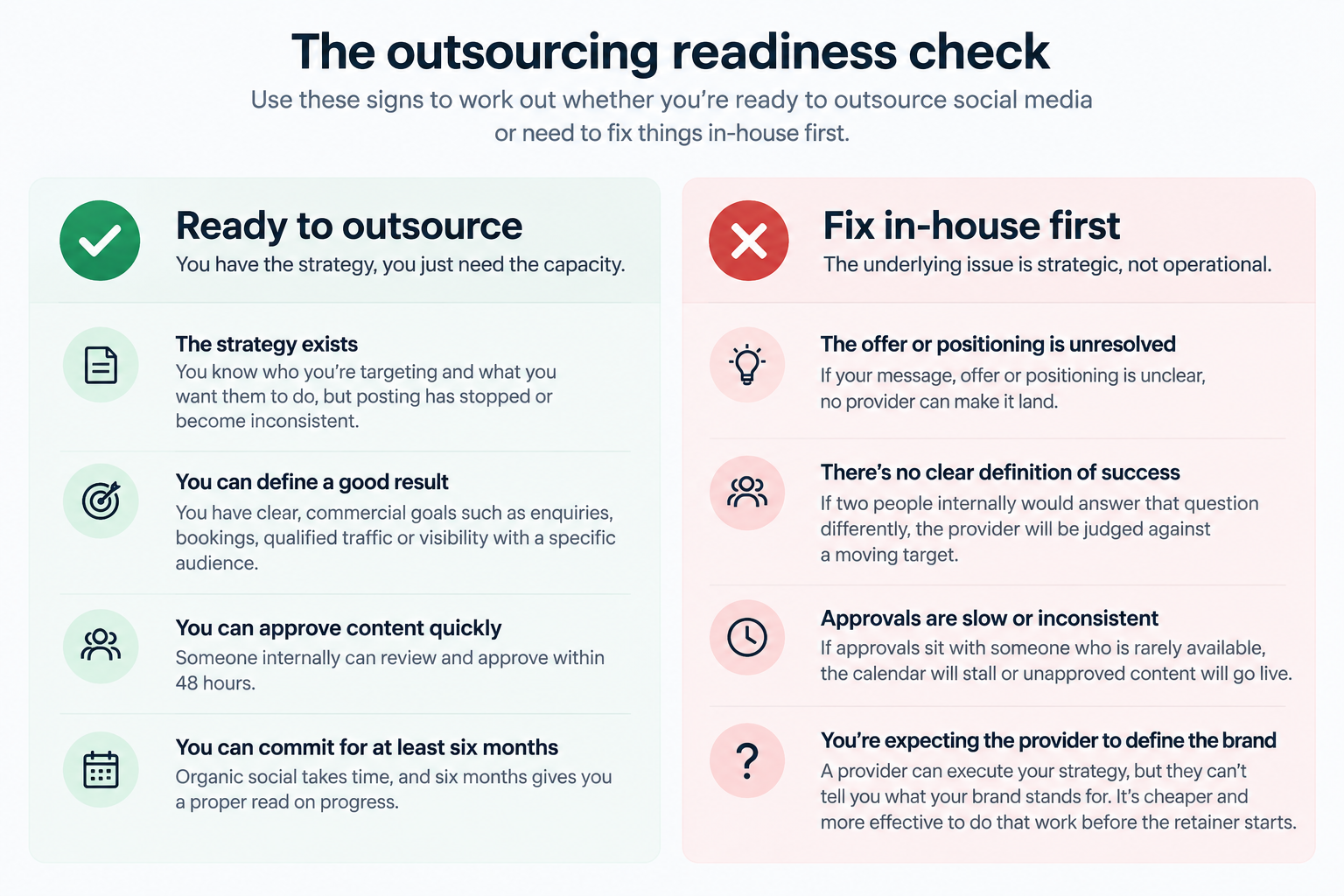
Outsource when you have a strategy and no capacity. Fix it in-house first when you have capacity and no strategy. That distinction decides whether the money produces anything.
You are ready to outsource when most of the following are true:
- The strategy exists but nobody has time to run it. You know who you are talking to and what you want them to do, and the posting has simply stopped or gone erratic.
- You can describe what a good result looks like. Not "more engagement", but something commercial: enquiries, bookings, qualified traffic, a specific audience you need to be visible to.
- Someone internally can approve content quickly. A 48 hour turnaround on approvals is the practical threshold. Slower than that and the provider's calendar stalls.
- You are prepared to give it at least six months. Organic social does not produce a clean read in eight weeks.
You should hold off when the underlying problem is strategic rather than operational:
- The offer or positioning is unresolved. No provider can make ambiguous positioning land, and a lot of what looks like a social media problem is actually a growth strategy problem showing up on the nearest channel.
- Nobody agrees on what success means. If two people internally would answer that question differently, the provider will be judged against a moving target.
- Approvals sit with someone who is never available. The provider will either stop publishing or start publishing unapproved work. Both end badly.
- You are hoping outsourcing will tell you what the brand stands for. That is your work, and it is cheaper to do it before the retainer starts than during it.
What should you outsource, and what should stay in-house?
The workable answer is almost never all-or-nothing. Most successful arrangements split the work along a single line: judgement about the business stays inside, execution of an agreed plan goes out.
The content production row is usually the one that frees up the most time, because it is where the hours actually go. If that is the bottleneck, a scoped arrangement covering content creation alone can be enough without handing over the whole channel.
Freelancer, offshore VA or agency: which outsourcing model fits?
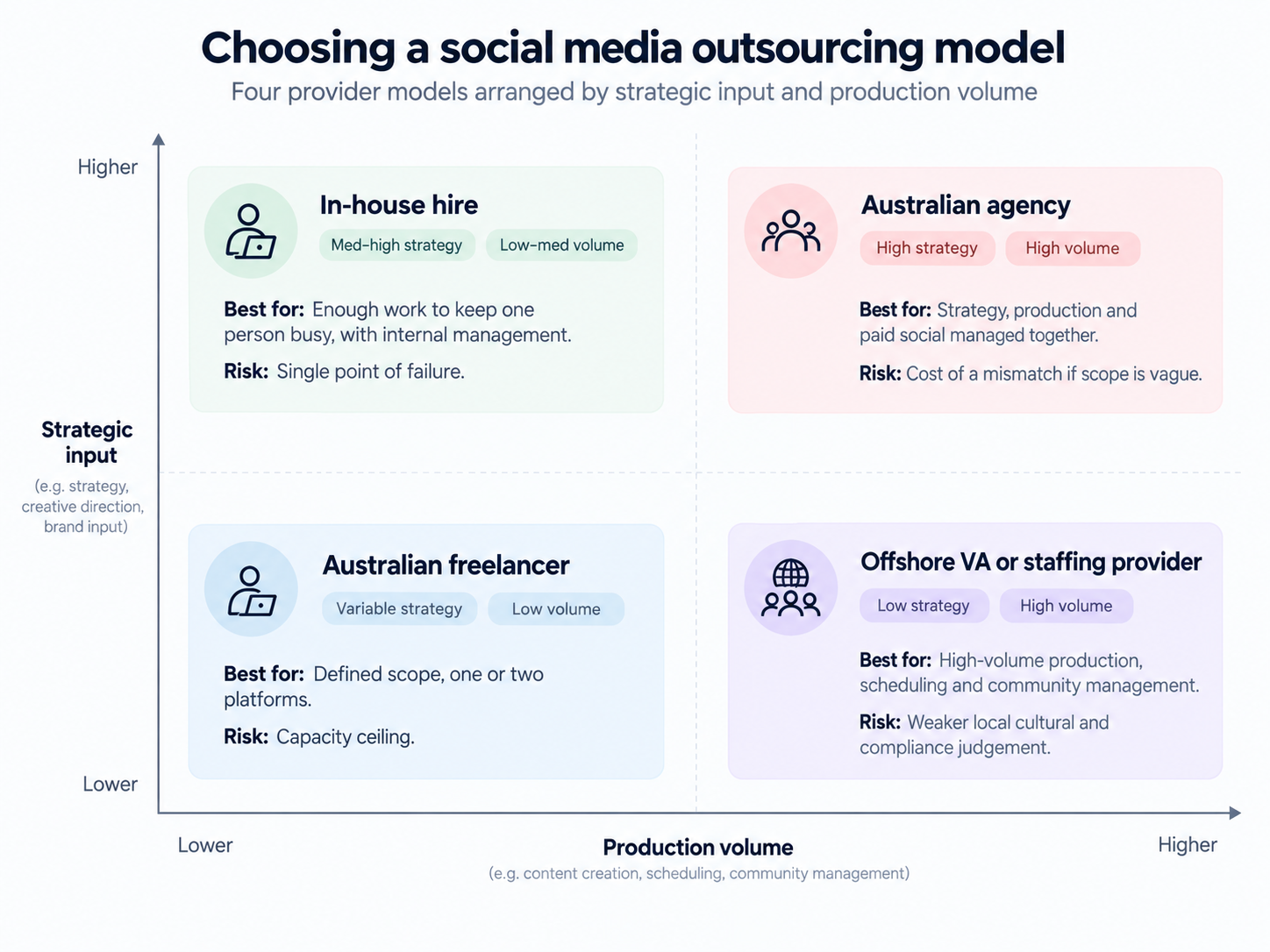
The right model depends on how much strategic judgement you need the provider to supply. If you have the strategy and need hands, a freelancer or offshore team works. If you need someone to build the strategy and be accountable for the commercial result, that is an agency arrangement.
Offshore providers deserve a fairer hearing than they usually get. For volume production, scheduling, first-line community management and asset resizing against a documented brief, they work well and they work at scale. Where they struggle is anything requiring cultural read: Australian humour, local references, knowing which news cycle to stay out of this week, and applying the AANA Code of Ethics to a piece of promotional content. Those are not skill gaps, they are context gaps, and no brief fully closes them.
The practical middle ground a lot of businesses land on is an Australian strategic lead with offshore production underneath. That works, but only when someone is accountable for the output before it publishes.
How to brief a social media provider so the work is actually good
Most outsourced social media underperforms because of a weak brief, not a weak provider. Work through these seven steps before the first post goes out.
- Define the commercial outcome, not the output. "Twelve posts a month" is a deliverable. "Forty qualified enquiries a quarter from social" is an outcome. Brief the outcome and let the provider argue for the output that gets there.
- Document the brand voice with real examples. Give three posts that sound right and three that do not, and say why in a sentence each. Examples travel further than adjectives.
- Agree the content pillars before anything is scheduled. Four or five themes, each tied to something commercial. Without pillars you get whatever the provider finds easiest to make.
- Set the approval process and a turnaround limit. Name one approver, one backup and a maximum turnaround. Approval by committee is the single most common cause of a stalled content calendar.
- Grant access properly rather than sharing logins. Add the provider as a partner or assigned user through Meta Business Manager and the equivalent permissions on other platforms. You keep ownership of the assets, and revoking access later takes one click instead of a password reset scramble.
- Agree the reporting cadence and the metrics up front. Decide monthly or fortnightly, decide which numbers matter, and put both in the scope. Retrofitting metrics after three months always looks like moving the goalposts.
- Run a short paid trial before committing to a long term. A one month scoped engagement tells you more about how a provider thinks and communicates than any pitch deck. Pay properly for it, because free trials attract the wrong behaviour on both sides.
Which platforms sit in the scope is worth settling at step three rather than assuming. Spreading the same budget across five channels usually produces worse results than two done properly, and the right platforms for your business depend on where your buyers actually are rather than where the volume is.
How do you know if outsourced social media is working?
Judge it on commercial movement and content quality, and give organic at least three months before drawing conclusions. Paid social reads faster, usually inside four to six weeks, because there is enough data volume to see a trend.
The metrics that indicate something real is happening:
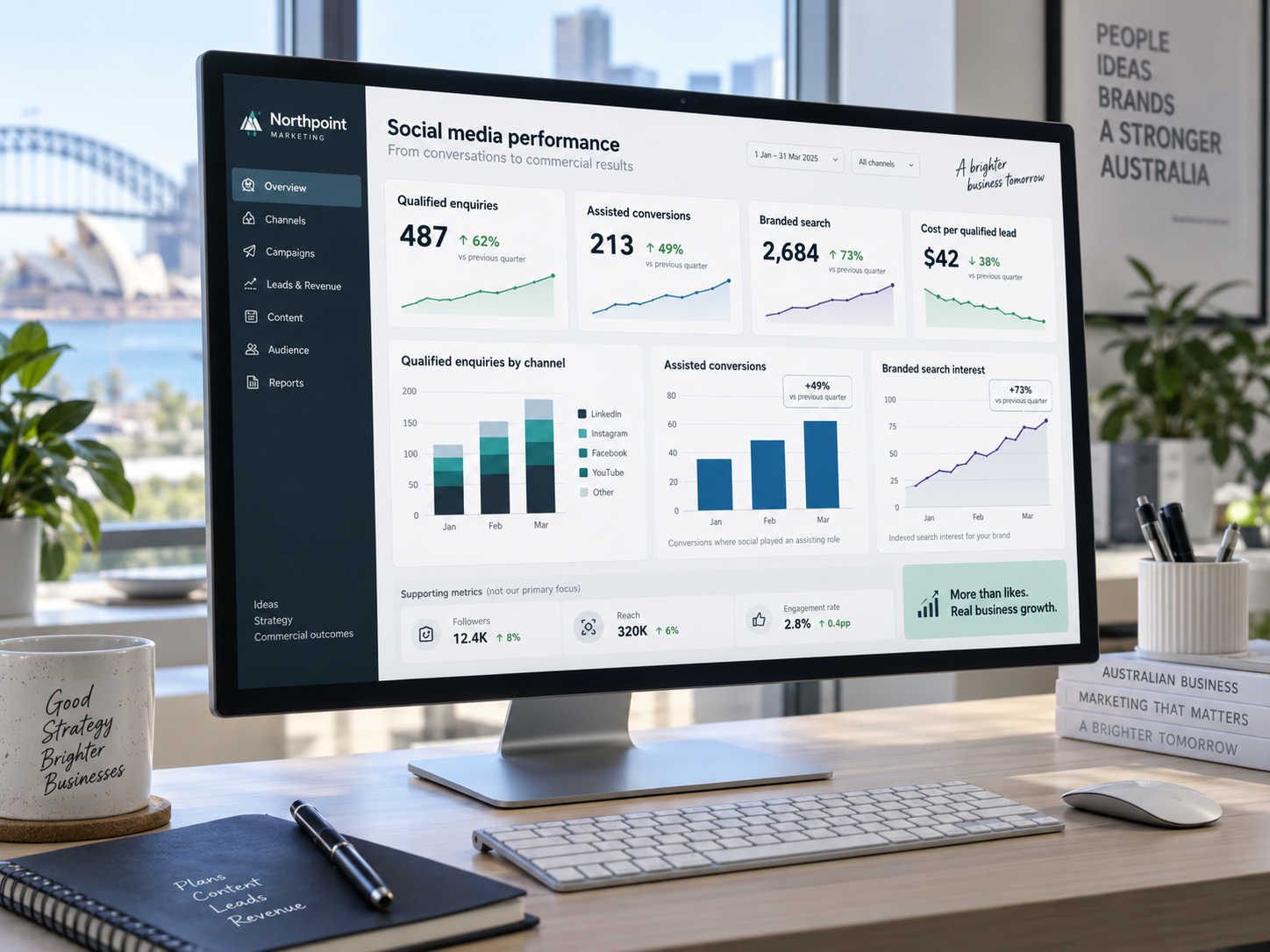
- Qualified enquiries attributed to social: the count and, more importantly, whether they are the right kind of enquiry.
- Assisted conversions: social rarely closes on its own, so look at where it sits in the path rather than only at last click.
- Branded search volume: rising searches for your name is one of the clearest signs social is doing its job.
- Cost per qualified lead on paid social: the number that decides whether the paid component scales.
- Saves, shares and profile visits: the engagement signals that actually correlate with intent, as opposed to likes.
Follower count and reach in isolation tell you almost nothing about commercial progress, which is why weak providers lead their reports with them. If you want to set this up properly before the first report lands, the framework for measuring social media performance is worth agreeing internally first so you are reviewing against your own definition rather than theirs.
Warning signs your social media provider is coasting
The clearest signal is a provider who has stopped asking questions about your business. Curiosity fades first, output quality follows.
- Reporting leads with reach and follower growth. These are the easiest numbers to make look positive and the least connected to revenue.
- The content could belong to any brand in your category. Swap the logo and nothing changes. That means the voice guide is not being used.
- Nothing has been tested in months. No new formats, no new hooks, no creative variation on paid. Coasting looks like consistency until you compare quarters.
- No questions about new offers or business changes. A provider paying attention asks what changed. One coasting works from the original brief indefinitely.
- Reports arrive late, or only when chased. Reporting discipline is the first thing to slip and the easiest to spot.
- You cannot name your day-to-day contact. Account churn on the provider side is usually invisible until the work degrades.
None of these on its own is fatal. Two or three together means the arrangement needs a hard conversation rather than a renewal.
Where to go from here
If social media has stalled and you are not certain whether the problem is capacity or strategy, that is the question worth answering before you brief anyone. Getting it the wrong way round is what turns a retainer into a sunk cost. Hackd works with businesses on social media strategy and delivery where the two sit together rather than being handed off separately, and the fastest way to work out what you actually need is to tell us what you are working with.
Frequently asked questions
1. Is it better to outsource social media or hire in-house?
Hire in-house when the volume justifies a full-time role and you have someone senior to direct them. Outsource when you need a range of skills (strategy, design, video, paid) that one hire cannot cover, or when the workload is real but not full-time. A junior in-house hire with no senior direction is the option that fails most often, because the person is set up to produce output without the context to make it land.
2. What should be in a social media outsourcing agreement?
Scope and deliverables, the approval process and turnaround times, the reporting cadence and agreed metrics, ownership of content and accounts, platform access arrangements, notice period and what happens to assets and access on exit. The exit clause matters more than people expect. Agree it while everyone is getting along.
3. Can you outsource social media and keep your brand voice?
Yes, but only if the voice is documented before the work starts. A written voice guide with real examples of on-brand and off-brand copy is the mechanism. Without one, the provider reverse-engineers a voice from your past posts, which locks in whatever was already inconsistent.
4. Is it worth outsourcing social media to the Philippines?
It works well for production volume, scheduling, asset resizing and first-line community management against a clear brief. It works less well where the output needs Australian cultural read or advertising compliance judgement. The common structure that succeeds is offshore production sitting under an Australian strategic lead who reviews before anything publishes.
5. How long before outsourced social media shows results?
Allow three months minimum for organic and four to six weeks for paid social. The first month is largely setup: voice, pillars, access, approvals and the first content batch. Judging an organic arrangement inside eight weeks means judging the onboarding rather than the work.
6. Who owns the content and the accounts if you outsource?
You should, and it should be in writing. Own the accounts at the platform level and add the provider through Meta Business Manager or the platform equivalent rather than sharing logins. Content ownership and licensing of any original photography or video should be stated in the agreement, not assumed.
7. What do you still have to do yourself after outsourcing?
Approvals, positioning and offer decisions, escalated complaints, anything that requires speaking for the business, and reading the reports properly. Budget a few hours a month for the client side of the relationship. Arrangements fail more often from internal neglect than from provider failure.


.png)

.jpg)